.svg)


How prebuilt business data models, pipelines, and analytics content shorten the path from operational SAP data to actionable insights.
Your Controlling team needs a reliable margin view. Sales wants order-to-cash figures without a three-week request queue. Procurement asks for spend analyses across suppliers. The data exists — in SAP. But between "the data exists" and "the business can act on it" sit weeks of identifying tables, reconstructing business logic, aligning hierarchies, and agreeing on KPI definitions. Only then does the actual analysis begin.
Microsoft is addressing exactly this gap with Business Process Solutions (BPS) for Microsoft Fabric: preconfigured data models, transformation logic, semantic structures, and analytics content for recurring business processes. Instead of building every analytics scenario from scratch, organizations start from a prepared business model.
Key Takeaways
- Business Process Solutions are Microsoft-provided building blocks in Microsoft Fabric for recurring analytics scenarios in Finance, Sales, Procurement, and Manufacturing.
- BPS standardizes the step between technical SAP data and usable business insights — models, KPIs, hierarchies, authorizations, and Power BI content are prebuilt.
- BPS is currently available as a public preview; scope and naming can still change as the Microsoft roadmap evolves.
- BPS does not replace SAP data provisioning. Reliable, selective SAP data extraction remains the prerequisite — and this is where SAP data provisioning from Theobald Software comes in.
Why SAP Analytics in Microsoft Fabric Is More Complex Than It First Appears
Organizations that want to use SAP data in a modern data and analytics platform quickly encounter a familiar challenge: the data is available — but not automatically in a form business users can work with directly.
SAP application data is distributed across numerous tables, views, and business objects. Add large data volumes, different access methods, technical and functional dependencies, and requirements such as hierarchies, translations, currency conversion, or authorizations. At the same time, SAP data is rarely enough on its own: it needs to be combined with information from CRM, procurement, planning, and other business systems.
This is exactly where the BPS concept comes in. The objective is not only to make data available in Microsoft Fabric, but to process it in a consistent business context from the outset.
What Are Microsoft Fabric Business Process Solutions?
Business Process Solutions are predefined building blocks for recurring enterprise analytics scenarios. Within Microsoft Fabric, Microsoft combines data integration, transformation, business logic, semantic models, and analytics content into one deployable solution.
Instead of first determining which data a finance, sales, or procurement use case requires, how that data is related, and which transformations are needed, organizations can start with prepared structures. The content is not a rigid end product, but a foundation that can be adapted and extended to individual requirements.
5 Benefits of Prebuilt Business Models for SAP Analytics
Which SAP Business Processes Does BPS Cover?
Microsoft is building BPS around recurring end-to-end business processes. The current Microsoft material focuses in particular on Finance, Sales, Procurement, and Manufacturing, while Supply Chain scenarios are being expanded over time. The exact preview and availability status of individual components may change as the roadmap evolves.
- Record to Report (Finance): Financial Statements, Profitability, Accounts Payable and Accounts Receivable, Financial Planning
- Order to Cash (Sales): Sales Orders, Deliveries, Billing, Customer 360, Opportunity Analysis
- Procure to Pay (Procurement): Purchase Requisitions, Purchase Orders, Goods Receipts, Vendor Invoicing, Spend Analysis
- Plan to Produce (Manufacturing): Manufacturing Orders, Operations, Components, Confirmations, and production analytics
The Microsoft Fabric BPS Architecture: From SAP Data to Insight
Microsoft's reference architecture makes it clear that BPS is about more than ready-made dashboards. The approach covers the complete data path from data provisioning and processing to business modeling, reporting, semantic models, and AI scenarios.
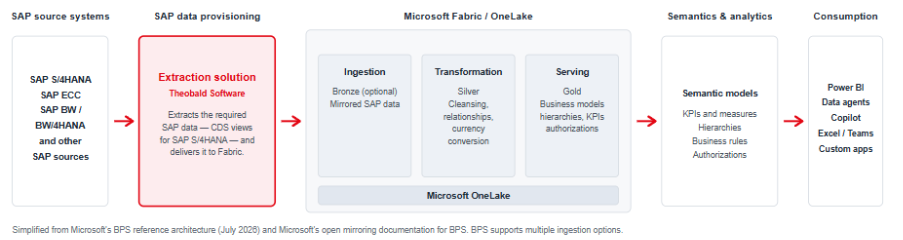
Step 1: SAP Data Provisioning and Ingestion
The process starts with reliably providing the required data from the source systems. Microsoft supports different ingestion options and a choice-of-extraction-tools approach. The BPS material considers both Microsoft-native paths and partner solutions for SAP data provisioning, explicitly pointing to partner capabilities for scenarios that require specialized extraction and advanced delta handling, particularly for SAP ECC and S/4HANA. For SAP S/4HANA and SAP ECC, Microsoft documents an open mirroring path in which the extraction solution handles ingestion and BPS processes the data from there. Extraction is configured in the extraction tool itself; in the BPS source system setup you simply select your mirroring partner. This is the path Theobald Software uses for Microsoft Fabric.
Read closely, Microsoft's own material sets out what the ingestion layer has to deliver:
- Selective extraction — the ability to pick exactly the objects a use case requires
- Reliable delta handling — incremental loads that stay consistent, whether the source is a CDS view or an SAP table.
- Large-scale scenarios — volumes that go beyond standard configuration
- Coverage beyond S/4HANA — SAP ECC and other ABAP-based sources
- Predictable load on the source system — extraction that operations teams can plan around
Keep that list in mind. It is the checklist against which any ingestion path into Microsoft Fabric should be measured.
Step 2: Transformation and Harmonization in Fabric
In the downstream Fabric layer, data is cleansed, related, and prepared for use. BPS follows a medallion approach in which data moves progressively from Bronze through Silver to Gold. Microsoft's reference architecture highlights capabilities such as massive parallel processing, relationship creation, currency conversion, and other transformation steps.
If you want to understand how these layers work with SAP data before looking at prebuilt content, our article on the medallion architecture in Microsoft Fabric walks through the Bronze, Silver, and Gold stages step by step.
Step 3: Business Layer and Serving in the Gold Layer
The Gold or serving layer is where business-oriented models are created: star schemas, hierarchies, aggregates, KPIs, and authorization concepts. This is where technically available data becomes a reusable business model.
Step 4: Analytics and AI with Power BI, Data Agents, and Copilot
The prepared data can then be used in Power BI and other Microsoft applications. At the same time, Microsoft positions the semantic models as a foundation for Data Agents and Copilot scenarios, enabling users to query business information in natural language.
Why Business Process Solutions Matter for Your Teams
In many analytics projects, the greatest effort is not spent on the dashboard itself, but on preparing the data. Which tables are required? How are they related? What business logic sits behind them? Which hierarchies, KPIs, and authorizations need to be considered?
BPS changes that starting point — and each role in the buying committee feels it differently:
- Business departments get answers to recurring questions in weeks rather than quarters, based on definitions everyone shares.
- BI and data teams stop rebuilding the same finance or sales logic for every project and work from reusable data products.
- IT decision-makers reduce recurring development and maintenance effort, and shorten the path to measurable ROI.
- SAP Basis and IT operations keep control of what is extracted from the SAP system, and how selectively it happens.
The approach becomes particularly interesting when multiple systems are involved. Microsoft explicitly positions BPS for cross-functional insights across previously siloed enterprise applications. SAP data can, for example, be combined with CRM or other business data and analyzed within a shared semantic context.
BPS as a Foundation for Data Agents and Copilot on SAP Data
Generative AI needs more than access to as much data as possible. For an agent to answer business questions reliably, it needs context: terminology, relationships, KPIs, hierarchies, and business rules must be modeled clearly and consistently.
This is where the semantic layer of BPS becomes strategically interesting. Microsoft plans for business data to be exposed through Data Agents and made available in Microsoft environments such as Fabric, Teams, Excel, or Copilot. These agents can build on predefined domain knowledge, KPIs, business rules, and hierarchies.
BPS therefore has the potential to evolve from an analytics accelerator into a foundation for AI-enabled business processes. The quality of those answers, however, is only ever as good as the SAP data underneath them.
Where Does SAP Data Provisioning Fit Into a Fabric BPS Architecture?
Business Process Solutions do not remove the need to reliably make SAP data available to Microsoft Fabric. They depend on an appropriate ingestion layer. This is where Xtract Universal.iQ comes in.
Keeping that ingestion layer current matters just as much as building it in the first place. Xtract Universal.iQ runs on scheduled extractions, so SAP data lands in OneLake on a cadence you define rather than through ad-hoc manual exports. Whenever a scheduled run delivers new data, the downstream BPS pipeline can pick it up and refresh the business model end to end — from transformation through to the reportsthemselves — so customers work from current figures instead of triggeringupdates manually or analyzing data that has already gone stale.
BPSis designed to process data in batches, and its pipelines are scheduled to runonce a day by default. That schedule can be customized so pipelines executemultiple times a day, letting organizations that need a shorter refresh cyclealign BPS more closely with how often Xtract Universal.iQ delivers new data.
They extract the SAP data required for the respective BPS use case, for SAP S/4HANA on the basis of CDS views, and delivers it into Microsoft Fabric through open mirroring. From there, BPS takes over. The division of responsibilities stays clear: Theobald Software provides the SAP data, while the BPS logic, transformation, business model, semantic layer, reporting, and AI consumption, resides in Microsoft Fabric.
Prebuilt On Both Sides Of The Architecture
BPS spares you the modeling groundwork. The provisioning side works the same way:
- Turnkey business templates: preconfigured extraction packages for areas such as sales, finance, and procurement, built on standard SAP CDS views — instead of designing an extraction pipeline for every use case.
- Configuration instead of code: two steps. Authenticate the SAP source connection, then point to the Microsoft Fabric open mirroring destination.
- Automated ingestion: from that point on, SAP data moves into OneLake through open mirroring and is ready for BPS transformation, reporting, and analytics without manual intervention. Becausethese extractions run on a defined schedule, the data BPS works with stayscurrent on its own, without a manualrefresh step.
The effect compounds: prebuilt extraction meets prebuilt business models, and the project starts in the middle rather than at zero.
That separation is intentional and useful. It also lets you take the checklist from Step 1 point by point:
- Selective extraction: only the CDS views and objects a BPS use case genuinely needs leave the SAP system — no full replication of tables nobody will model.
- Delta handling: stable delta processes on CDS views rather than a nightly batch load, so recurring analytics scenarios stay current throughout the day.
- Large-scale scenarios: high volumes from finance, sales, or logistics are what the extraction layer is built for.
- Coverage beyond S/4HANA: CDS views for SAP S/4HANA, and the extraction paths that SAP ECC, SAP BW, and SAP BW/4HANA provide — relevant for the many landscapes that will run mixed for years.
- Predictable load on the source system: selective, incremental extraction keeps the footprint on SAP plannable, which is usually the decisive argument for SAP Basis teams.
Two things sit above that list. You get SAP-compliant, trusted, and reliable SAP data extraction as a property of the overall solution from Theobald Software. And you avoid vendor lock-in: the same extraction layer serves Microsoft Fabric today and other targets tomorrow, so your architecture decisions stay yours. Theobald Software has been building this since 2004; around 1,700 organizations worldwide rely on it, backed by an in-house development team and personal support.
Theobald Software is a Microsoft ISV partner and an SAP partner, and the collaboration with Microsoft is a strategic one that goes well beyond a single integration point. The solutions are listed in Microsoft's open mirroring partner ecosystem for change data capture from SAP into Microsoft Fabric, offers dedicated destinations for OneLake and open mirroring, and evolves alongside the Fabric roadmap and continuous technical alignment as new Fabric capabilities are released.
The division of responsibilities in one sentence: Theobald Software provides the relevant SAP data. Microsoft Fabric BPS turns it into preconfigured, business-oriented data models, analytics content, and a foundation for AI scenarios.
Example: Record to Report Without Starting from Scratch Every Time
Traditional finance analytics require data from the General Ledger, Accounts Receivable, Accounts Payable, and other areas to be brought together. Hierarchies, currencies, and financial-statement structures also need to be considered.
With BPS, Microsoft provides prepared content for scenarios such as Trial Balance, Financial Statements, Profitability, and Accounts Payable and Accounts Receivable analytics. The underlying data is first provided from SAP, then processed in Fabric, and finally made available through semantic models and Power BI content.
The key difference is the starting point: the project does not begin with an empty data platform, but with an already structured business-process model that is then adapted to your requirements.
Conclusion: Business Context Is the Real Accelerator
Microsoft Fabric Business Process Solutions address one of the central challenges of data and analytics projects: value is not created by access to data alone, but by translating technical data structures into understandable, reusable business models.
With preconfigured models for key business processes, an end-to-end Fabric architecture, and integration with Power BI and Data Agents, Microsoft is standardizing more of this journey. That is particularly relevant for SAP customers, because the complexity of the source systems remains while the recurring modeling effort can be significantly reduced.
Reliable SAP data provisioning remains the prerequisite. In combination with Xtract Universal.iQ as the ingestion layer, organizations rely on established SAP data integration while using the business-process logic in Microsoft Fabric. The resulting architecture is clear: SAP data is provided selectively and reliably, modeled in a business context in Fabric, and then made available for analytics and AI.
Discuss Your SAP-to-Fabric Scenario With Us
Every SAP landscape is different: source systems, data volumes, delta requirements, and governance rules vary. and so does the right ingestion path into Microsoft Fabric.
Contact us and discuss your scenario. We will look at your SAP sources, your Fabric target architecture, and your BPS use cases together, and show you what reliable SAP data provisioning looks like in your setup.

