.svg)

SAP Integration with Microsoft Fabric
Microsoft Fabric provides an end-to-end analytics and data platform for data movement, processing, ingestion, transformation, real-time event routing, and reporting. Our Microsoft Fabric SAP Connector, Xtract Universal, transfers data from SAP ERP, SAP BW, BW/4HANA, and S/4HANA directly into OneLake, Azure SQL, or Synapse Analytics. You update data incrementally, leverage Open Mirroring, and use flexible ODP alternatives, ensuring SAP data integrates efficiently, remains current, and requires no manual adjustments in Microsoft Fabric.



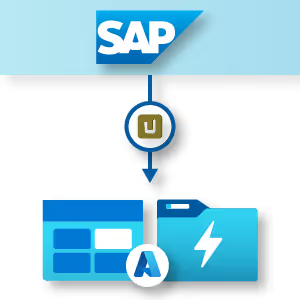
Efficient SAP integration with Azure Cloud
Learn more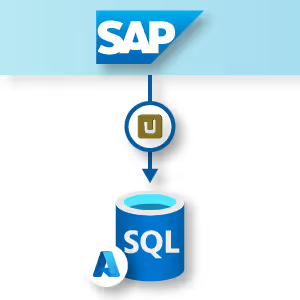
Maximum performance for your SAP data
Learn more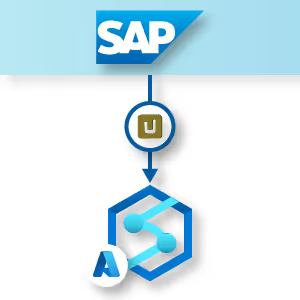
Fast and reliable SAP data analytics
Learn more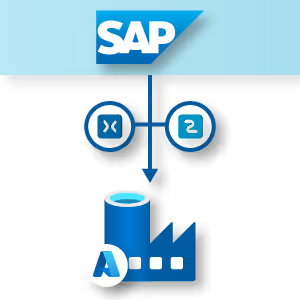
Automated processing of SAP data
Learn moreThe Challenge: Integrating SAP Data into Microsoft Fabric
Integrating SAP data into Microsoft Fabric involves several key factors:
- Real-time processing of large datasets: Critical business data from finance, logistics, or sales needs to be available almost instantly.
- Complex data structures: High volumes and diverse SAP objects complicate integration.
- ODP limitations: SAP Note 3255746 restricts the use of ODP Data Replication APIs for ABAP sources, which may require adapting or redesigning existing workflows.
Companies need a solution that reliably extracts, processes, and transfers SAP data into Microsoft Fabric without disrupting existing processes, enabling real-time analysis.
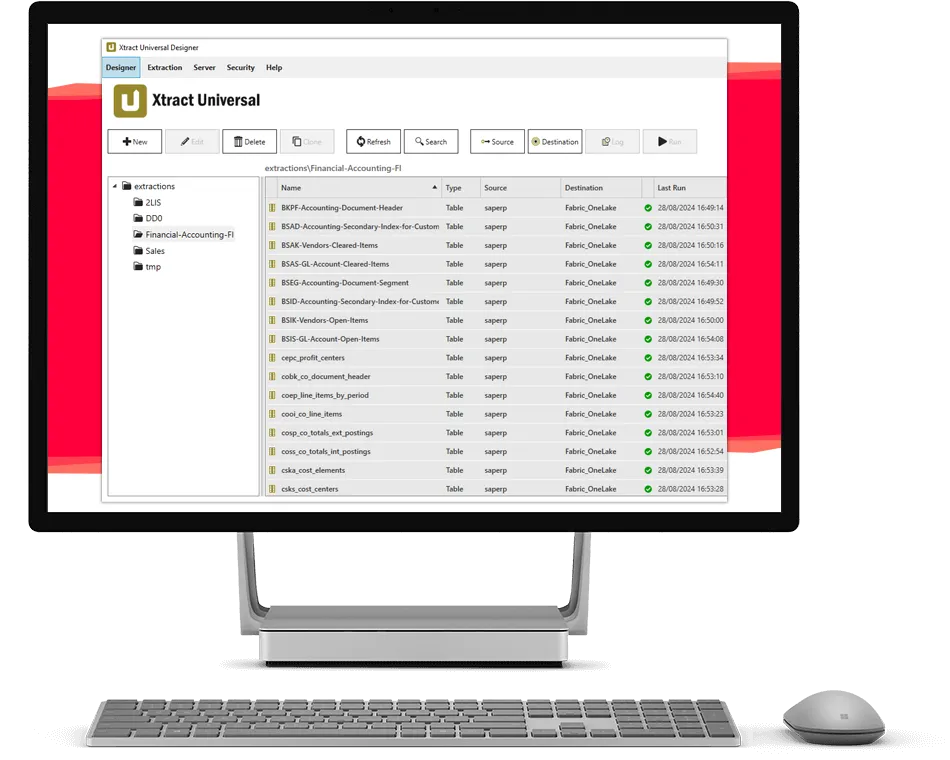
The Challenge: Integrating SAP Data into Microsoft Fabric
Integrating SAP data into Microsoft Fabric involves several key factors:
- Real-time processing of large datasets: Critical business data from finance, logistics, or sales needs to be available almost instantly.
- Complex data structures: High volumes and diverse SAP objects complicate integration.
- ODP limitations: SAP Note 3255746 restricts the use of ODP Data Replication APIs for ABAP sources, which may require adapting or redesigning existing workflows.
Companies need a solution that reliably extracts, processes, and transfers SAP data into Microsoft Fabric without disrupting existing processes, enabling real-time analysis.

Your Solution: Xtract Universal as an SAP Interface for Microsoft Fabric
Xtract Universal connects SAP and Microsoft Fabric directly and independently of ODP restrictions. An overview of the most important functions:
- SAP data extraction: Supports data from ERP, BW, BW/4HANA and S/4HANA.
- data integration: Transfers data efficiently to OneLake, Azure SQL, or Synapse Analytics.
- Incremental updates: Uses CDC and DeltaQ to keep data up to date without full reloads.
- SAP Mirroring Fabric: Automatically merges incremental data with existing data sets.
- Flexible and future-proof: Supports ODP alternatives, open mirroring, and large amounts of data, so that all SAP data is available in an optimal format for analysis.
With it, you can analyze data up to date at any time, avoid performance problems and make SAP integration with Microsoft Fabric efficient and robust.

Your Solution: Xtract Universal as an SAP Interface for Microsoft Fabric
Xtract Universal connects SAP and Microsoft Fabric directly and independently of ODP restrictions. An overview of the most important functions:
- SAP data extraction: Supports data from ERP, BW, BW/4HANA and S/4HANA.
- data integration: Transfers data efficiently to OneLake, Azure SQL, or Synapse Analytics.
- Incremental updates: Uses CDC and DeltaQ to keep data up to date without full reloads.
- SAP Mirroring Fabric: Automatically merges incremental data with existing data sets.
- Flexible and future-proof: Supports ODP alternatives, open mirroring, and large amounts of data, so that all SAP data is available in an optimal format for analysis.
With it, you can analyze data up to date at any time, avoid performance problems and make SAP integration with Microsoft Fabric efficient and robust.

Flexibility and Efficiency in SAP Data Integration
Xtract Universal offers a wide range of components to process SAP data efficiently and flexibly:
- Table, Table CDC, and DeltaQ for incremental and full data loads
- ODP extension supporting both RFC modules and the OData API
- Change Data Capture (CDC) and SAP DataSources to minimize resource usage
- Optimized mass data processing that avoids performance bottlenecks and conserves resources
This enables companies to integrate large SAP data volumes into Microsoft Fabric efficiently and resource-consciously, perform real-time analytics on up-to-date data, and simultaneously simplify their IT processes.
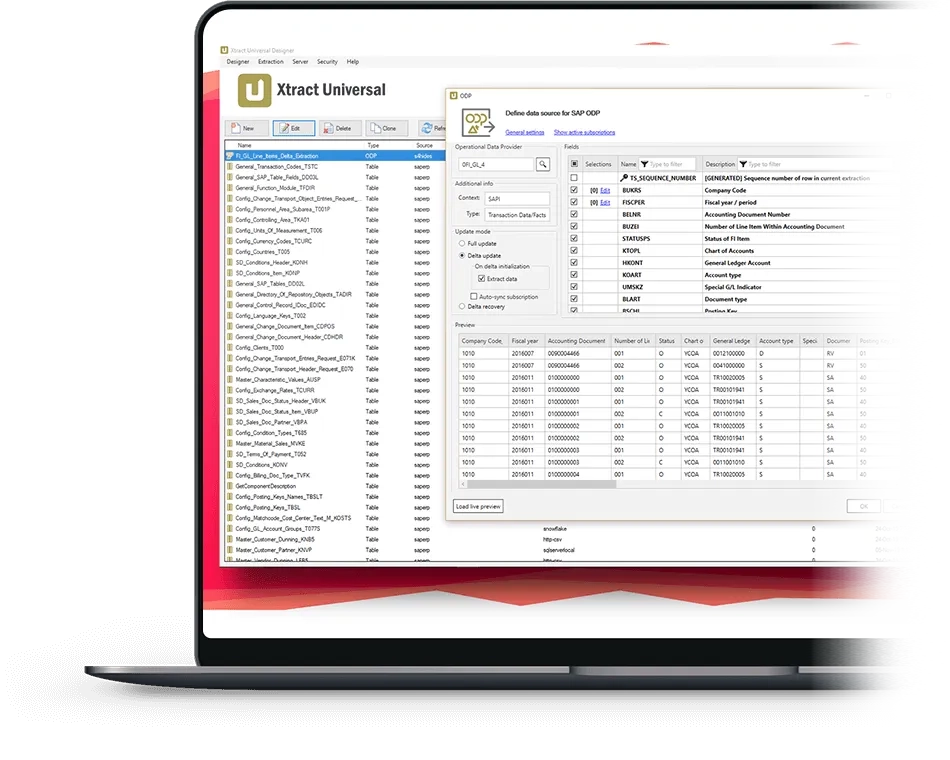
Flexibility and Efficiency in SAP Data Integration
Xtract Universal offers a wide range of components to process SAP data efficiently and flexibly:
- Table, Table CDC, and DeltaQ for incremental and full data loads
- ODP extension supporting both RFC modules and the OData API
- Change Data Capture (CDC) and SAP DataSources to minimize resource usage
- Optimized mass data processing that avoids performance bottlenecks and conserves resources
This enables companies to integrate large SAP data volumes into Microsoft Fabric efficiently and resource-consciously, perform real-time analytics on up-to-date data, and simultaneously simplify their IT processes.
Whitepaper: SAP Data Integration with Microsoft Fabric
Get deeper insights into SAP integration with Microsoft Fabric in our detailed whitepaper.
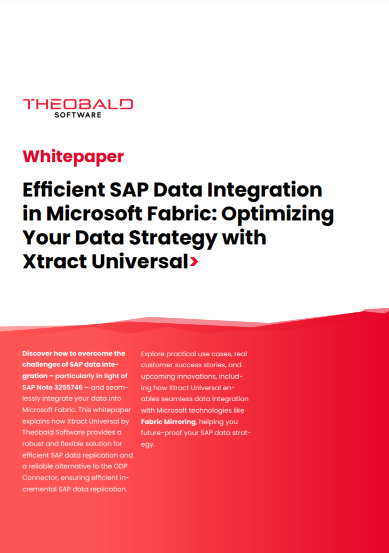
Rely on a central data foundation with Microsoft Fabric – for data-driven strategies that impress.
Your Advanages with Xtract Universal
Our customer LANXESS has aligned its digitalization strategy with Microsoft Azure and required an efficient solution for transferring data from SAP ERP and BW systems. With Xtract Universal, a powerful interface was implemented, enabling automated bulk data extraction. Over 500 employees benefit from fast, incremental data transfers, which are crucial for timely, data-driven decisions.

When we build an extraction once, it runs automatically as many times as needed. Since many of our projects require SAP data multiple times a day, this brings a huge time advantage. Furthermore, Xtract Universal allows bulk data to be extracted extremely quickly and incrementally. This is crucial, for example, for retrieving the SAP table BSEG (accounting documents) to provide consuming applications with up-to-date data.

Application Scenarios
Replicating SAP data into OneLake offers a range of benefits specifically designed to help departments and teams manage, analyze, and gain deeper insights from their data more efficiently while reducing costs and ensuring data security. Some of these benefits include.
Optimized Data Analysis with SAP and Microsoft Fabric
The controlling team of a company faces the daily challenge of quickly and accurately evaluating financial metrics to make informed budget decisions. With Xtract Universal, the controlling staff can replicate SAP data directly into OneLake. This provides them with real-time access to current and historical financial data, enabling them to analyze it instantly. As a result, they can immediately identify areas for cost savings or areas requiring investment, leading to improved financial planning and decision-making.
Enhanced Data Availability with SAP and Microsoft Fabric
A sales team distributed across multiple regions needs constant access to up-to-date customer data and sales statistics to develop targeted sales strategies. By replicating SAP data into OneLake with Xtract Universal, sales employees can access the required information anytime and across various devices and platforms. Whether in the office, on the field, or on the go, they can always view current sales figures, analyze customer histories, and adjust sales strategies to achieve their goals.
Cost-Effective Data Management with SAP and Microsoft Fabric
The IT department is usually responsible for enterprise-wide data management and system administration, ensuring that data is efficiently, securely, and cost-effectively managed. By centrally storing SAP data in OneLake with Xtract Universal, the IT team can avoid redundant data storage and reduce associated storage and management costs. Additionally, administrative effort is reduced as fewer systems and storage locations need to be managed, enhancing IT team efficiency and freeing up resources for other strategic IT projects.
Data Security and Compliance with SAP and Microsoft Fabric
With Xtract Universal and the storage of SAP data in OneLake, compliance officers can ensure that all company data meets the highest security standards. OneLake’s built-in security features protect data from unauthorized access, allowing the team to quickly and easily provide any necessary evidence during audits. This not only strengthens regulatory compliance but also reduces the risk of compliance violations
How Xtract Universal Works with Microsoft Fabric
- SAP Data Extraction: Supports data from tables, BW InfoCubes, BEx Queries, and DataSources, which can be seamlessly integrated into the structure of Microsoft Fabric.
- Data Integration into OneLake: SAP data is directly transferred into OneLake – the central data platform within Microsoft Fabric – providing a unified foundation for analytics and reporting.
- Incremental Data Updates: With Change Data Capture (CDC) and DeltaQ, data can be efficiently and resource-conservingly updated without the need for full reloads.
- Optimized Data Merging with Fabric Mirroring: Fabric Mirroring enables the automatic merging of incremental SAP data with existing datasets in Microsoft Fabric. Xtract Universal ensures that the SAP data is available in the optimal format to support this process seamlessly.
- Compatibility with Microsoft Services: Seamless integration with Microsoft services such as Azure Synapse Analytics and Power BI to enable end-to-end analytics.

Test Xtract Universal for Microsoft Fabric Free for 30 Days
Want to Integrate SAP Data Efficiently into Microsoft Fabric? Test Xtract Universal for Free or Discuss Your Individual Use Case with Us Directly!
FAQ: Frequently Asked Questions About SAP Integration With Microsoft Fabric
